
About the author
Grant Gipe writes literary fiction shaped by the belief that time changes everything except the questions we continue asking ourselves.
His novels explore memory, identity, regret, and the quiet ways our lives are rewritten through reflection. Rather than recreating the past, his work asks what remains of it—and what those memories continue to teach us decades later.
He believes fiction can reveal emotional truths that facts alone cannot.
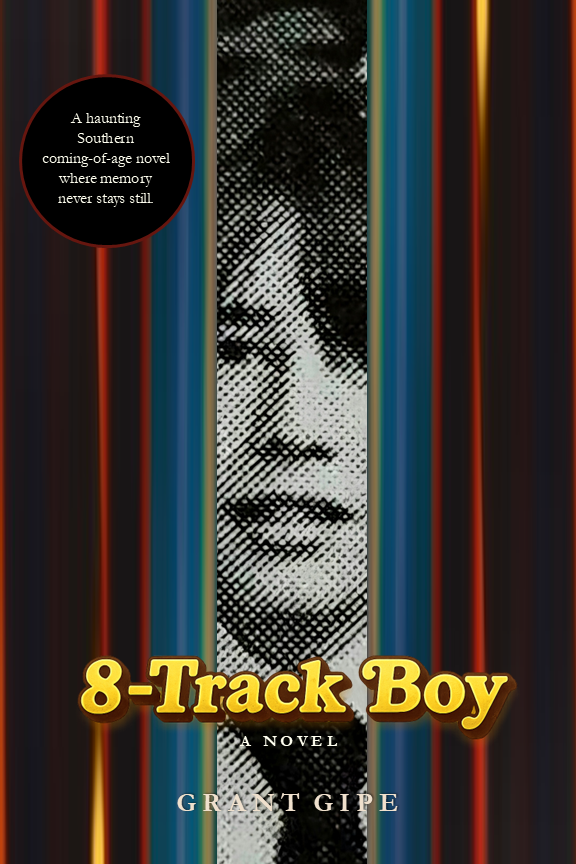
8-Track Boy is his debut novel.

"I don't write to preserve the past. I write to understand what time has made of it."
author STATEMENT
I have always believed that the stories which stay with us the longest are the ones we have no choice but to tell.
8-Track Boy lived quietly in the back of my mind for more than four decades before I finally understood why I needed to write it. Time had changed the memories, but more importantly, it had changed me. Only with distance could I begin to understand what those experiences had meant.
That belief continues to shape everything I write.
I am less interested in recreating the past than I am in understanding it. Memory is not a recording of our lives; it is an ongoing conversation between who we were and who we have become. Every time we revisit the past, we bring a different version of ourselves with us.
For that reason, I have never been drawn to memoir. Facts alone rarely capture emotional truth. Fiction creates the freedom to ask deeper questions, to imagine different outcomes, to confront uncomfortable ideas, and to explore experiences that feel emotionally authentic even when the events themselves are imagined.
My novels return repeatedly to memory, identity, regret, friendship, loss, and the passage of time—not because I believe they have simple answers, but because they are the questions that continue to define us long after childhood has ended.
I have come to writing later in life, and I see that as a gift rather than a disadvantage. Experience has taught me that understanding rarely arrives in the moment. It comes years later, often quietly, after enough time has passed for reflection to replace certainty.
I also believe literature should be courageous. It should not avoid difficult subjects simply because they make us uncomfortable. Fiction has always been one of the safest places to ask dangerous questions, to challenge accepted truths, and to examine the parts of ourselves we would rather leave unexplored.
Every novel is, in its own way, an act of legacy.
Long after we are gone, stories continue the conversations we began, carrying our questions, our doubts, and our humanity into the hands of people we will never meet. If my work leaves anything behind, I hope it is not answers, but curiosity—the willingness to look again at the lives we have lived and ask what they were trying to teach us all along.